Art-Bastide

Welcome to our Art-Bastide Blog

The workshops will begin in 2027; bookings open from November 2026.

Didier Balsac, Tournon at Heart

Editor Marie Sornin

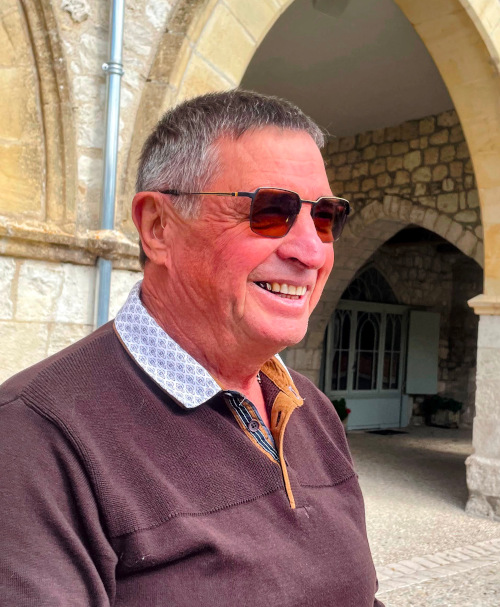
When Didier Balsac talks about Tournon, he does not begin by talking about himself. He talks about the streets, the square, the school, the shops, the campsite, the heritage. Yet it soon becomes clear that these places are closely intertwined with his own story.

The son and grandson of local councillors, he was first elected in 1989 and joined the municipal council in 1995. Fourth deputy mayor, then second, then first, he accompanied the different stages of the village’s transformation before becoming mayor in 2014. Out of conviction. Out of a passion
for the role and a love of the village. And along the way, he developed his own very clear vision of what Tournon could become.

Didier BalsacA beautiful village, not a museum

The village’s inclusion in the Les Plus Beaux Villages de France network in 2021 was an important
milestone. But what stands out in his account is not so much the distinction itself as everything that
made it possible.

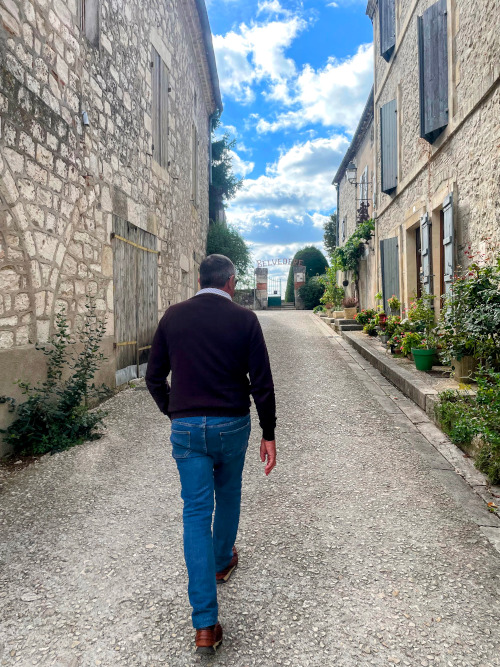
The streets were restored, the central square redesigned, and particular attention was paid to
planting. He did not want a village made entirely of stone. He remembers the Tournon of his
childhood, with its vineyards, rose bushes and plants.

He involved local residents, asking them what they would like to see outside their homes. Today,
some of them maintain the spaces they helped choose. The stone has therefore regained its place,
but alongside greenery, life and everyday use.

When a development proposal does not fit his vision, he is decisive:
“No, no, I don’t want that. Because I already know what I want to do afterwards.”
While preparing the application for the designation, he discovered, or rediscovered, lesser-known
aspects of Tournon’s history. Among them was the surprising 1950s water-tower bell tower, which
intrigued the expert who came to assess the village so much that it became one of the curiosities
highlighted in the application.
Didier Balsac already has another idea in mind: access to the top, an orientation table and a
viewpoint from which visitors could understand the bastide and the landscape around it.
Passing things on, helping people discover them... and preserving them.

Two Tournons to keep alive

“You could say that the mayor of Tournon has two villages to manage,” he says with a smile. Up above, there is the bastide, its heritage, visitors, restaurants, artists and craftspeople. Down below, there is “operational Tournon”: the school, shops, services, facilities, residents and
economic activity.

The challenge, and it is not a simple one, is to make the two work together, reconcile different views and give the whole village a common direction.
The development of the campsite has brought in visitors and boosted local activity. Food markets have found their place on the central square, an exhibition of craftspeople now returns every summer, the school has moved from the upper town to a more suitable facility below, while the former school building is being given a new purpose.

Taken separately, these are simply municipal projects. Put together, however, they reveal a clear intention: to keep Tournon alive and thriving.
He also talks readily about what has yet to be done. The Jardin de l’Octroi, the path that will eventually connect the lower town to the old ramparts, housing for young families, homes adapted to older residents, the future of local shops...

He does not see Tournon as a finished product, but as a village in motion.

Didier_Balsac_Maire_Tournon_d_AgenaisAnd then comes Art-Bastide

Within this vision, Art Bastide is not simply another project added to a list. It is a piece of the puzzle: a place capable of bringing people to Tournon who might otherwise never have come. Artists, workshop participants and visitors, but also professionals attending seminars or other events.

Bo Filarski’s idea quickly appealed to the mayor. He remembers the day she came to present it to him: “Right from the start, I said: this woman is remarkable.”
He was impressed by her experience, her energy, her communication skills and her ability to
recognise a promising project and turn it into reality.

Of course, he thinks about the economic activity it could generate, but he also sees an opportunity to strengthen the village’s emerging artistic identity, create connections and increase its visibility by bringing art and heritage together.

The former school, with its generous spaces and large windows, will take on a new function without completely losing its history. It will no longer be a school, but neither will it become a place without a memory.

The support of the Town Hall and Municipal Council will prove decisive in getting the project off the ground. As an honorary member of the association, Didier Balsac is involved in it according to the same principle that seems to have guided his work for years: helping Tournon evolve, giving people new reasons to come and stay, without erasing what makes the village what it is.


A commitment to nature

Yet behind the projects and municipal files, any portrait of Didier Balsac would be incomplete without mentioning his attachment to nature.
A former farmer, he and his wife chose, in the early 2000s, to convert their farm to organic agriculture. He describes the feeling of wanting to move away from a form of farming where, eventually, you can end up working almost mechanically: spraying because an adviser tells you to,
producing, starting again.

“I really enjoyed farming organically, protecting nature and understanding it,” he says with conviction. He talks about water, drought, wildfires, birds and the animals he observes around his home. He is also interested in the way renovations can remove the natural shelters that wildlife depends on.

At one point, he and his wife considered turning an old barn into a holiday rental. The plans were well advanced... until they thought about the swallows, which nested there in large numbers. “The barn stayed exactly as it was.” Some priorities are non-negotiable.

Tournon tomorrow

What will Tournon look like tomorrow? For Didier Balsac, the answer is not some grand theoretical master plan. It lies instead in a series of very concrete choices: allowing children to stay, welcoming new families, keeping local shops alive, attracting craftspeople, opening the village to artists, maintaining the paths, protecting nature and making the most of its heritage.

Not choosing between the past and the future. Because although Didier Balsac seems to have a very precise idea of what Tournon should be, it is
not the idea of an static village. It is the idea of a village that continues its story.

And in that story, he still has a few more chapters in mind.

The workshop dates are on line Click for:  painting dates - metal art dates - ceramics dates


_______________

Art Bastide: The Artistic Adventure Begins Here

Editor Marie Sornin

Steve &
        HarveyWhen Bo Filarski learns that Tournon’s primary school is going to move to new premises, she immediately imagines what could be done with the old building’s spacious rooms and generous windows: workshops, of course! The connection to the arts she shares with Steve Maker and Harvey Freer does the rest.
What begins as an informal conversation soon turns into a discussion about possibilities. All three have been living in Tournon for several years and share a desire to promote and bring new life to the village they have chosen. Bo knows exactly what it takes to run a large-scale artistic workshop, having created Europe’s largest ceramics workshop in Lorraine. Steve and Harvey bring their long experience of the art world, as well as their understanding of what people coming here for an artistic stay might need.

The idea takes shape, making use of this space right in the heart of the bastide: the old school will host weekly workshops led by established artists, from painters and metalworkers to ceramicists and specialists in shibori printing and textile dyeing. The local council, won over by a project that also highlights the village’s heritage, lends its support. Artbastide is born.

Steve and Harvey become founding members. This kind of project is something they never seem to tire of. They have always been drawn to places where ideas circulate, skills are passed on and works of art have stories to tell. And Tournon won them over with its unspoiled beauty, its landscapes and its light. For them, helping the village develop does not mean transforming it, but rather helping it share what already makes it unique, while making sure it remains protected.

Preserving What Deserves to Stand the Test of Time

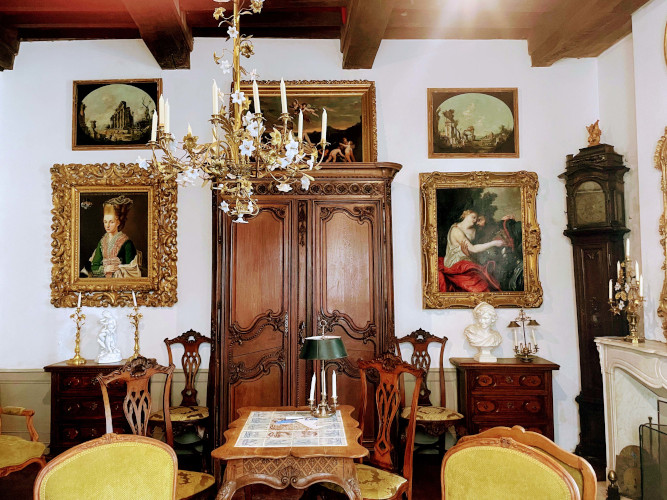
Like many people during the pandemic, Steve Maker and Harvey Freer found themselves spending more time in front of their computer. At the time, they were living near Portland, Oregon, where they had devoted much of their lives to art. As they browsed online, an almost improbable property listing caught their attention: an old 13th-century house in the heart of the bastide of Tournon-d’Agenais, in the Lot-et-Garonne. Without ever having seen it, and without knowing the village, they bought it and decided to make it their home. For more than thirty years, Steve Maker and Harvey Freer ran The Cultured Pearl, a well-known gallery in Portland’s Pearl District: “the place to be,” as Steve puts it with a mischievous smile. Their expertise and passion for art made the gallery much more than a simple business. People came for the paintings, antiques and antique frames, but also to meet, discover, exchange ideas and talk about art.

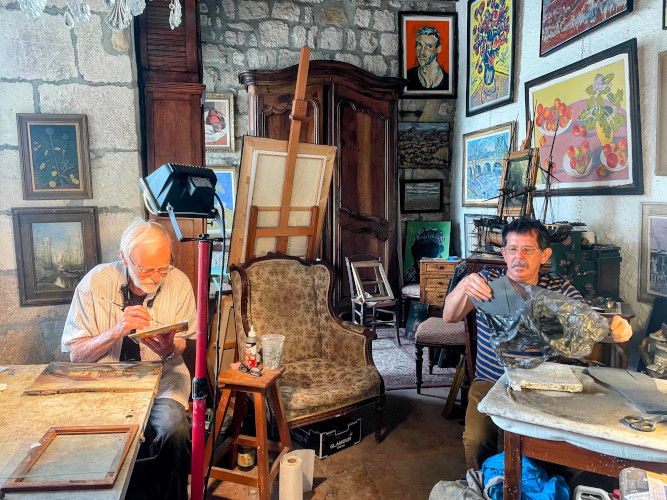
Henri-IV-House-1They restored works that were sometimes in very poor condition and regularly travelled throughout Europe, particularly France, in search of antiques and unique pieces.
Steve, a painter, has devoted part of his work to the vast landscapes of Oregon and to the faces of Indigenous peoples of North America. His interest in the latter seems to be rooted more in memory and identity than in folklore. The faces, in particular, are treated with restraint, with meticulous attention to the eyes and the gaze. He also paints extensively the landscapes of Oregon: forests, mountains and the shores of the Pacific. Here again, what stands out is the light, never showy, almost silent.

Harvey paints too. He was also a musician, playing the bassoon and oboe in several classical orchestras. In his landscapes, he seems less interested in faithfully reproducing a place than in capturing its atmosphere. Light is suggested rather than described; the vastness of the space seems to embrace emptiness. The result is an impression of calm, silence and a slight sense of strangeness, as though the landscape had first been observed and then reconstructed in the mind.

A House Like a Work of Art to Be Restored

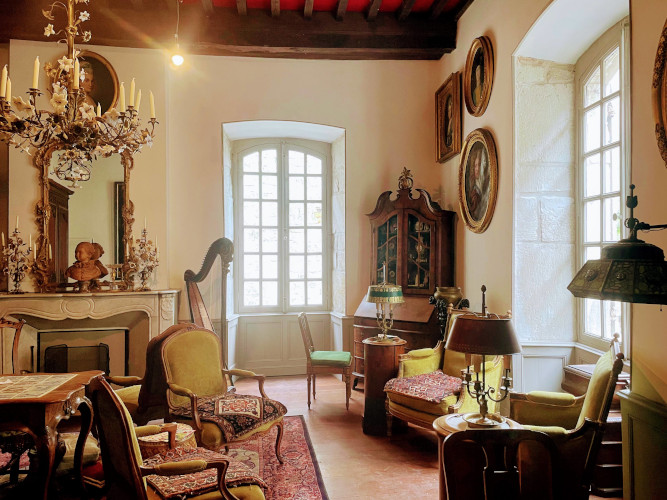
When Harvey and Steve discover their house in Tournon, it has been abandoned for nearly fifty years. Many people would have seen a daunting renovation project. Not them. They see the volumes, the tired old stone, the various attempts at restoration carried out over the years, some more successful than others, and an intriguing potential that captivates them. They work tirelessly on the house, bringing it back to life with the same passion and respect they bring to works of art.

Henri-IV-House-2As Harvey puts it: “This isn’t renovation. It’s restoration.” And that philosophy can be seen in the choices they have made: preserving the old Quercy stone wherever possible, reconfiguring certain rooms to highlight the high ceilings, giving new purpose to alcoves and little hidden corners, and carefully preserving the very old, wide-planked wooden floors…

The rooms have come back to life, filled with furniture, paintings and objects that have themselves been carefully restored.Their expertise does not remain confined behind their own door. Among other projects, they rescued a large old painting from a church in Tournon-d’Agenais, allowing the work to reclaim its place in the village’s heritage. It was very much in this spirit of sharing knowledge and expertise that they became involved in the creation of Art Bastide.

Steve and Harvey always have a project underway: a new artistic form to explore, a canvas to paint, a room to bring back to life. When they talk about this constant activity, you can see that they are thinking not only about the projects they have already mentioned, but also about other ideas still taking shape. They smile, shrug their shoulders in a gesture that is, somehow, very French…

They each have their own particular style, but both share a clear, incisive gaze, and a serene one too. There is patience in the way they look at you. You sense that they see what is there, but also what could be there; that they see a future, a possibility for transformation: in the very old house they inhabit, in the objects around them, and in everything that surrounds them. Perhaps this is what comes from spending a lifetime deeply committed to the work of research and preservation, while retaining a youthful desire to keep creating, exploring and undertaking new things. Some things, after all, never change. Do they?

___________


When a fortified town becomes a workshop: Tournon-d'Agenais, a village that inspires artists

Editor Marie Sornin

What is this magic that draws artists to Tournon d’Agenais? Is it the location of this 13th-century bastide, perched high on its hill, as if written in the sky? Or should we attribute this mystery to its understated beauty, which has earned it a place among the “Most Beautiful Villages of France”?

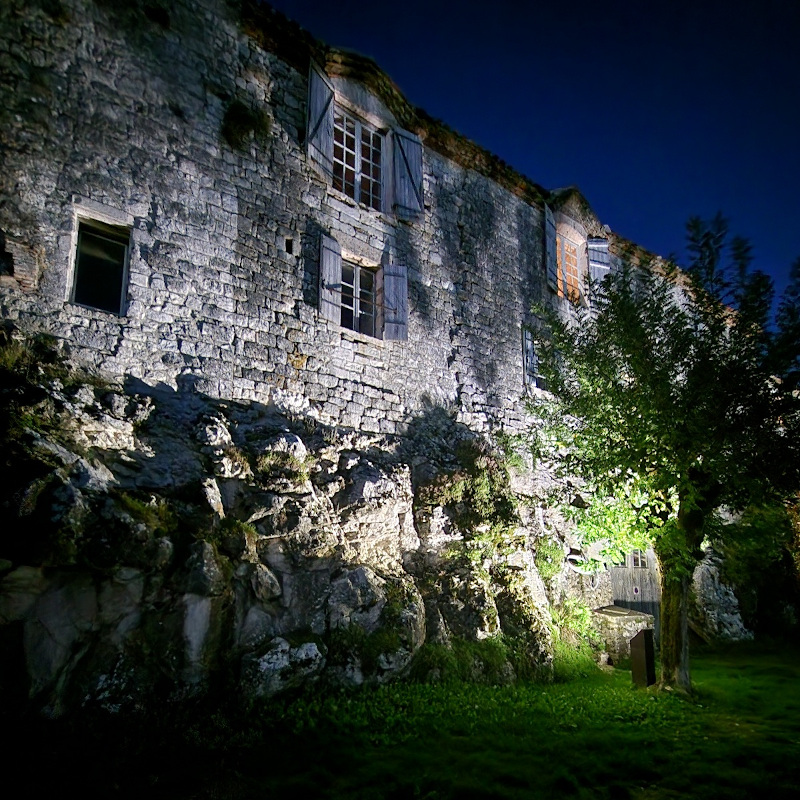
Is it because Tournon d’Agenais does not seek to stage itself and that its checkerboard streets, its Beffroi, its very old half-timbered houses, are not a decoration? For they are, in truth, a substance: in the walls, in the volumes of the houses, in a quality of tangible and benevolent presence, in the impression that time works differently there.

Tournon
            d'Agenais

Artists have this particular ability to perceive atmospheres. They seek out places that offer space to observe, reflect, and experiment. And when a place speaks to them in this way, they stay, sometimes for a few weeks, sometimes for the rest of their lives. In Tournon, they open studios, restore old houses, exhibit in the alleyways, or reinvent the use of old buildings.

It's a story that repeats itself, with variations. Artists passing through the Southwest - some coming from far away, from the Netherlands, the United States or elsewhere - discover the bastide almost by chance, return, buy, settle down.

These are renowned artists in their respective disciplines: ceramicists, painters, metal artists, and more. They chose Tournon. This choice speaks volumes about the connection that can develop between a region and an artist: artists don't just come looking for a pleasant place. They seek an environment that nourishes their creativity.

Working in a house several centuries old, restoring walls that have stood the test of time, creating amidst landscapes unchanged for centuries… Heritage, even very old, even laden with collective memory and tradition, is not an obstacle to modernity. It broadens the scope of creation. It is an anchor in time and in matter, which gives depth to the creative act.

Art Bastide: making creation a collective story

Artists can love a place without really belonging to it. They work there for a while, then leave.

Art Bastide's ambition is different: to make creation a natural component of village life, not just a one-off event. Weekly workshops, artistic stays, residencies, future art center in the old school... the idea is to build with the village, not simply in the village.

By crossing a territory where creation is present - where workshops are open, where works interact with old buildings, where someone has taken the time to take a long look at what we are passing through by car - something changes in our outlook.

Heritage inspires artists. Artists, in turn, reveal their unique vision. And the emotion it evokes unlocks that innate ability that lies dormant within us: the ability to perceive the beautiful and the unusual, the energy and strength in what we see, and to create a personal narrative from it. Perhaps all it takes is a beautiful, welcoming country house, an open studio... and a few people who have decided to stay a little longer than planned. ***

In upcoming articles, we'll be visiting some of these studios. Each one tells its own story about why certain artists come to Tournon-d'Agenais... and why they stay.

___________

The hidden treasures of Tournon d’Agenais

Editor Marie Sornin

Tournon d'Agenais

When I first discovered Tournon-d'Agenais, I was exhausted. Exhausted by the large city where I had been living, a city that had gradually taken from me - with my active cooperation, I must admit - an essential part of myself: something that had shrunk, worn down by chaos, speed, and the constant pressure to do more, faster, better.

Then one day, I looked out over the countryside surrounding an old house I was considering buying, and there it was: an inhabited silence, vast rolling landscapes, and a soft bluish light (it was raining) that nevertheless felt gentle and welcoming. They came to me with both tenderness and certainty, like long-forgotten friends returning what I had surrendered without realizing it.

Some riches never appear on tourist maps. There are no signposts, no entrance tickets, not even a souvenir shop on the way out. Yet they are generously offered to anyone who takes the small roads leading to Tournon-d'Agenais: silence, space and light, three inexhaustible local treasures that are ecological, renewable, and completely free.

Silence: The First Modern Luxury

You don't realize how constant noise is until it truly disappears.

A city dweller's first reaction is sometimes a slight sense of unease. Then comes the discovery that this silence is not hostile at all. It is a friendly silence, one that gently wraps itself around you.

It is never completely empty: a bird calling from a hedgerow, the wind moving through the trees, a tractor rattling in the distance, providing a counterpoint to the surrounding serenity. The hills, the hilltop villages and the winding roads around the village seem to have made a long-standing pact of non-aggression with the world's restlessness.

Science is beginning to document what this kind of silence can do: it restores. It allows the nervous system to loosen its grip, thoughts to slow down, and creativity to rise back to the surface.

Tournon d'Agenais

Space: A Geography of Breathing

The countryside around Tournon-d'Agenais does not try to impress. There are no vertiginous peaks, no overwhelming landscapes. Instead, there are gently rolling hills, broad valleys and fields that create large expanses of colour.

There is something deeply regulating about this sense of space. When the eye can travel into the distance, something changes in the body. Shoulders relax. Breathing deepens. One rediscovers a human scale that is often lost in cities, where even an ordinary building seems to diminish the sky.

The small roads winding between Tournon-d'Agenais, Penne-d'Agenais, Villeréal and Montflanquin cross landscapes that seem entirely indifferent to urgency. Driving slowly is not a constraint here. It is an invitation. Perhaps even a philosophy.

Light: The Landscape's Quiet Artist

Lot-et-Garonne is not Provence. It does not possess the hard white light that scorches stone, saturates colours and makes every Instagram photograph look like an advertisement for rosé wine.

Its light is more discreet, more subtle: golden in the morning on the hillsides, bluish in the valley bottoms at dawn, copper-toned in the evening as the sun slips behind the hills.

It transforms the same field into ten different paintings depending on the hour. It can make the medieval hilltop villages, of which Tournon-d'Agenais is a remarkably intact example, appear almost unreal at certain moments of the day, suspended between earth and sky in a luminous haze.

This light works with you, never against you. Delicate backlighting, reflections on stone and luminous skies influence the rhythm of daily life. One observes. One waits for the right moment. The seasons matter. The hours matter.

Fundamental Resources

Silence, space and light are not minor bonuses to be mentioned after the markets and the bastide towns. They are the very heart of what this countryside has to offer.

In a world of information overload, increasingly dense cities and omnipresent screens, these "invisible" resources answer fundamental human needs that are difficult to name yet deeply felt: The need for slowness. The need for emptiness. The need for authentic beauty.

I bought the old house. As I write these words, I am bathed in the gentle light of the morning, looking out over the peaceful valley. Life is beautiful.

Come and discover these hidden treasures for yourself. At our Artbastide center, you'll discover a world apart, far from mass tourism, traffic jams, the frenetic pace of life, and the pressure to perform. This isn't an art competition, but a journey of discovery in the company of like-minded people, centered around the traditional crafts we offer. A workshop where you create your own pieces and appreciate the process in an enchanting setting.
__________


Tournon Art-Bastide is coming

Bastide_de_Tournon_d_Agenais

Art-Bastide is an Artistic and Crafts center with four different disciplines.

With a team of nine founders and five teachers/artists, we have been preparing this fantastic project for two years. We expect to launch in the spring of 2027.
Art-Bastide will be located in the former primary school of the royal bastide of Tournon d’Agenais.
The city council and aldermen have approved the project.

There will be workshops in Shibori printing, textile dyeing, fine art painting, metalworking, and pottery. There will be weekly workshops for local residents, and themed vacations will be offered. We will work with local restaurateurs and B&Bs for accommodation and meals. We are also exploring with several psychologists the possibility of offering workshops for mildly autistic young people in the future.

But there is still much to be done. The building needs to be adapted. Toilets, electricity, etc.
Some teachers/artists have already settled in Tournon, while others are still looking for housing. We are working on a major international marketing plan, with this platform as its central hub. Along with the administrative and financial tasks, this is a massive undertaking, carried out by the volunteers of the Arts Tournon d’Agenais foundation. This foundation is the leading and responsible force in the Art-Bastide project.


We are also in contact with local B&B restaurateurs to ensure everything runs smoothly.
This project will also fit within a broader regional crafts project.


If you have any questions or if you know of a B&B that can offer rooms, please send a message to: contact-association-ATA


Vieuw_from_the_BastideFurthermore, we are fortunate to have already received a considerable number of donations that have made the initial launch of this project possible. Ultimately, we hope to create a structure where a self-financing system will provide a sound financial foundation for the project. But it will be clear, before we get there, that we still need a lot of money to get started. Every donation is welcome, see the donation tool down below.


But all these facilities would be nothing if five excellent teachers/artists hadn't agreed to commit to this project. I invite you to click through the various tabs on this site and discover for yourself who will be there.

I hope to visit you at our center in the future, and I invite you to subscribe to our newsletter now to stay informed about all the upcoming events.


Bo Filarski (Presidente of Arts Tournon d’Agenais / Art-Bastide)


Form to subscribe to our newsletter
 
To stay informed about all new course dates and events from Art-Bastide
Click here